
The conclusion of COP 28 in Dubai, United Arab Emirates marks the end of the first Global Stocktake set forth by the Paris Agreement. This process, which largely assesses the progress of countries at achieving their nationally determined contributions and collective progress towards keeping global temperature rise below 1.5 degrees Celsius, lays the groundwork for countries to revise their climate action goals and identify new opportunities to improve adaptation, resilience, and other relevant environmental and sustainability policies moving forward. Though the merits of the final resolutions resulting from this process and the negotiations over the two-week event have been hotly debated by policy experts and environmental activists since the end of the conference, with some celebrating the outcomes as a sign of victory and left others deeply unsatisfied (though I won’t get into it much in this blog post, you may notice that I align more with the latter group as you read on), one recurring theme of the conference that stood out to me as particularly inspirational: engaging youth voices and promoting activism amongst younger generations, such as in Global Stocktake procedures and the implementation of solutions to the climate crisis, is critical to achieving global climate policy goals. Throughout my five days attending COP 28, I found the presence of young leaders and the urgency of their messages to be particularly impactful, and was one of the only reasons that I left the conference with any glimmer of hope regarding the state of our future.
My COP 28 experience kicked off on Day 9 of the thirteen-day program, which happened to be the Youth, Children, Education, and Skills day on the overall conference thematic agenda. This topic immediately piqued my interest – in addition to earning my MPP at UofM, I am working towards an MS in Environment and Sustainability specializing in Behavior, Education, and Communication, and spent several years working as an environmental educator. Environmental education has been a part of my life since I was nine years old. I would not be where I am today without having grown up surrounded by a community that empowers young people to challenge the status quo and take action in the face of social and environmental injustices. The young speakers I listened to during various sessions on this day and throughout the rest of the week evoked the passion and determination to address critical climate issues in ways that reminded me of my mentors from my environmental education days who inspired me to join this movement in the first place.
One session that was particularly informative and moving was entitled, “The Climate Catalysts: Youth and Local Leaders Spearheading Action in the Climate Emergency.” This event, which was co-hosted by the Marrakech Partnership (an organization that brings together actors across all levels of government and other relevant stakeholders to address global climate impacts) and YOUNGO (the official constituency of children and young people of the UNFCCC) featured young several climate activists from across the world that played an important role in facilitating Local Stocktake initiatives to support the implementation of ambitious climate policies and commitments at the local and national levels. For example, one young speaker shared her experiences convening intergenerational stakeholders and organizing workshops in the City of Nairobi to establish a dialogue that better integrates the voices of individuals across all generations, specifically children and younger people, whose perspectives are often neglected in local, national, and international climate policy contexts. This conversation shed light on the importance of instituting multilevel governance structures that balance representation of demographics such as age, gender, ethnicity, and persons with disabilities to ensure that policies are poised to meet the needs of all citizens.
This Climate Catalysts session, amongst others I attended with a youth engagement focus, were among the most solution-oriented conversations that I witnessed throughout the week. This felt especially true when contrasted with the formal negotiations taking place, where word-smithing and semantics regarding final resolution language dominated discussions. I also attended several session on topics such as ocean conservation efforts, sustainable fashion, and greenhouse gas inventory metrics where seasoned professionals focused on progress that has already been made (e.g., “more brands are starting to talk about the need for an energy transition…”), or where changes must be made to avoid future environmental disasters (e.g., “we need to advance to a standard set of sustainability metrics for reporting efforts,”), without directly mentioning how we can make that transition. While I don’t believe these sessions were altogether useless, but I often left with more questions about the intermediary steps that are needed to get from where we are now to the place that our global leaders purport our world will look like five, ten, thirty years from now.
Interestingly enough, I found that the sessions highlighting young people tended to fill this gap by detailing pathways to implement and fund innovative, realistic solutions to existing challenges. For instance, the University Expo Live Innovation Program event convened university students from across the United Arab Emirates to pitch creative, in-progress solutions to various climate and sustainability problems currently facing the region in hopes of earning grant money to more efficiently bring the solution to market. From new desalinization technologies to waste-reduction methods for the seafood industry, the student entrepreneurs showcased how their solutions will accomplish local climate goals in addition to the why.
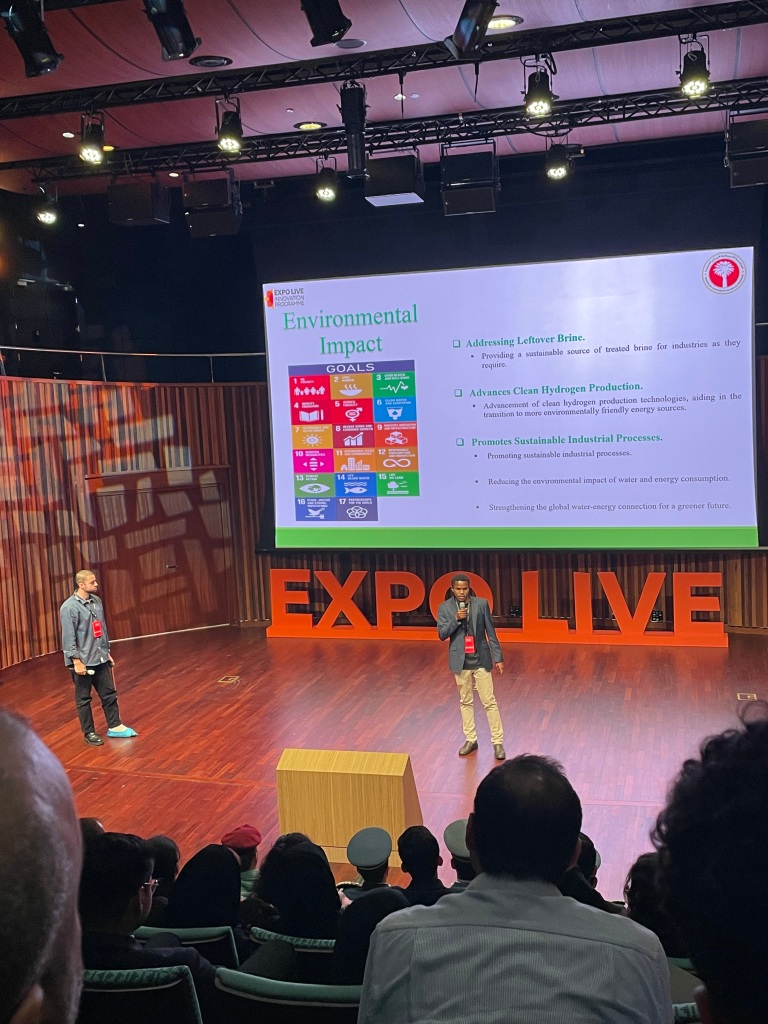
Maybe it’s just my background and belief in youth education speaking, or my general frustrations with the formal climate policy negotiations process and outcomes from COP 28, but for one reason or another one of my greatest takeaways from COP 28 is that young people are really, really powerful. Young people can lend new ideas and viewpoints from which longstanding world leaders can learn from, and hopefully incorporate into their own contributions to decisions as important as our global climate goals. Ultimately, the actions and inactions stemming from the decisions of our governmental leaders will be realized in the future (and current) lives of younger generations. Why not give them a seat at the decision-making table now?
 Climate Blue