
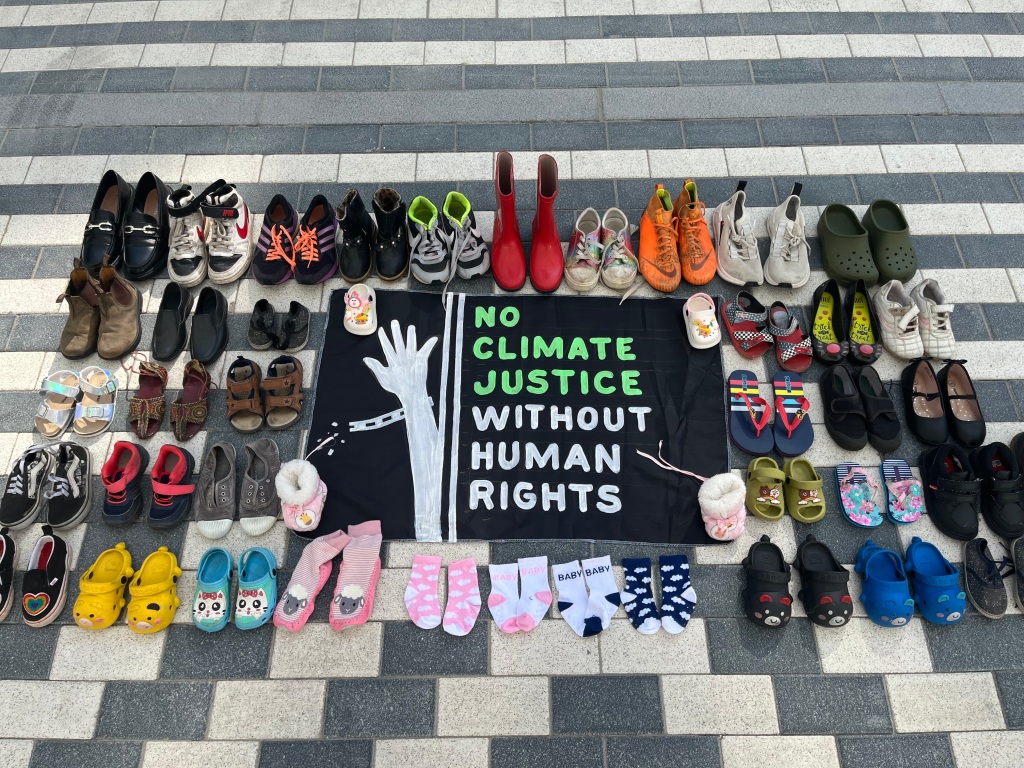
“No Climate Justice Without Human Rights!”
This phrase was on the lips of activists at COP 28, and it highlights the critical importance of a focus on human rights in the ‘just transition’ to a greener future. Unfortunately, however, human rights discussions at the conference often played second fiddle to some of the sexier topics this COP, both in terms of the space and times allotted, as well as in attendance, in the search for a single silver bullet to solve the climate crisis. Throughout COP 28, Human Rights Defenders valiantly endeavored to draw the attention of distracted and overwhelmed policy-makers to the lodestar of human rights to guide their efforts, the effects of climate change in exacerbating existent inequalities, and the human focus that is, after all, why we’re all trying so hard to limit global warming to 1.5 degrees Celsius.
This is not to say that COP 28 didn’t center human rights at all. The COP 28 presidency identified gender equality as a thematic priority within the conference agenda, intending to “ensure women’s equal participation in UNFCCC processes, promote gender-responsive climate action, and drive the systematic transformation needed to achieve the objectives of the Paris Agreement.” To this end, there were many firsts at COP 28: the first-ever Women and Gender Pavilion, the first Youth Climate Champion (“a ministerial-level position meant to bridge gaps between governments and other officials and young climate activists”), and the impactful International Youth Climate Delegate Program (which fully funded the capacity-building of one hundred young people from around the world to enable them to participate in the negotiations). This COP also played host to the first “global stocktake,” which hopes to rachet up individual states’ action and commitments on climate change significantly by the end of the decade. The commitment from this COP, which was designed by over 200 Parties, calls for governments to not authorize new fossil fuel projects, and for the end of all support for oil, gas, and coal developments.
Most notably for human rights, the Loss and Damage Fund (LDF), which is designed to assist developing countries that are especially vulnerable to the adverse effects of climate change, was finally operationalized. While what exactly constitutes “loss and damage” is not formally defined, it is broadly understood to refer to the impacts of climate change that cannot be addressed by mitigation or adaptation and which will disproportionately affect developing countries and island states. Given the global power dynamics surrounding the issue of climate change, wherein the most severe carbon emissions contributors are often those most capable of dealing with the concomitant negative effects of the climate crisis, this operationalization is extremely important, allowing for some of the states that contributed least to the crisis, but that will be most affected by its negative weather impacts, to cope. The ‘fair, fast, and feminist’ implementation of the LDF will be the focus of human rights organizations in the decades to come.
However, the spaces devoted to human rights at COP 28 often felt like an afterthought, divorced from the high-level negotiators making the real decisions. Is the focus on human rights at COP 28 real, or is it mere bread and circuses?
“There must be no room for greenwashing”
This phrase, uttered by United Nations Secretary-General António Guterres at COP 28, represents one of the many concerns that permeated the conference. One of the largest omissions within the Gender Action Plan was the extreme need for the gender mainstreaming of climate finance, which the UNDP has stated represents only 0.01% of global funding. The role of COP 28 in green-washing, youth-washing, and pink-washing was discussed throughout the conference in hushed tones, most often in the debate over fossil fuels and what many see as the UAE’s hypocritical role as a major oil producer hosting a climate conference. The human rights abuses of migrant workers in the UAE and the dismal human rights record of the UAE were glaringly absent from discussion. These discussions echo the criticisms of COP 27, hosted in Egypt, which raised related human rights concerns about that state’s treatment of civil society, the greenwashing of Egypt’s human rights record, and the brutal state of human rights overall in Egypt. These criticisms, and the worsening situation in Gaza, cast a pall upon the conference and overshadowed positive changes, particularly the focus on elevating the voices of youth and women.
There were also allegations of tokenization throughout the human rights discussions. While representatives of indigenous communities were present at consultations and negotiations, their concerns and desires were underrepresented in the negotiation texts. This tokenization was framed in terms of the larger power imbalance between different parties at the conference, where the larger (and more environmentally-disruptive) parties played key roles in designing the Loss and Damage Fund, while indigenous groups found its total size to be woefully inadequate for the climate impacts that their communities face. Likewise, women in positions of power were underrepresented throughout the conference, with only 15 of 110 heads of state at COP 28 being women. According to an analysis of the Women and Gender Constituency, only 64 countries out of 190 mention references to women or gender in their Nationally Determined Contributions (NDCs), and only 22 countries referred to women or gender as a cross-cutting issue, mainstreamed across several sectors.
Overall, this COP raised lots of questions. Should the environmental and human rights records of potential host states be considered in the selection process for future COPs? What more can be done to mitigate the human cost of the climate crisis? Should COPs even continue to exist in their current form, given the negative climate impacts of collecting 80,000 people together in the middle of a desert?
 Climate Blue