
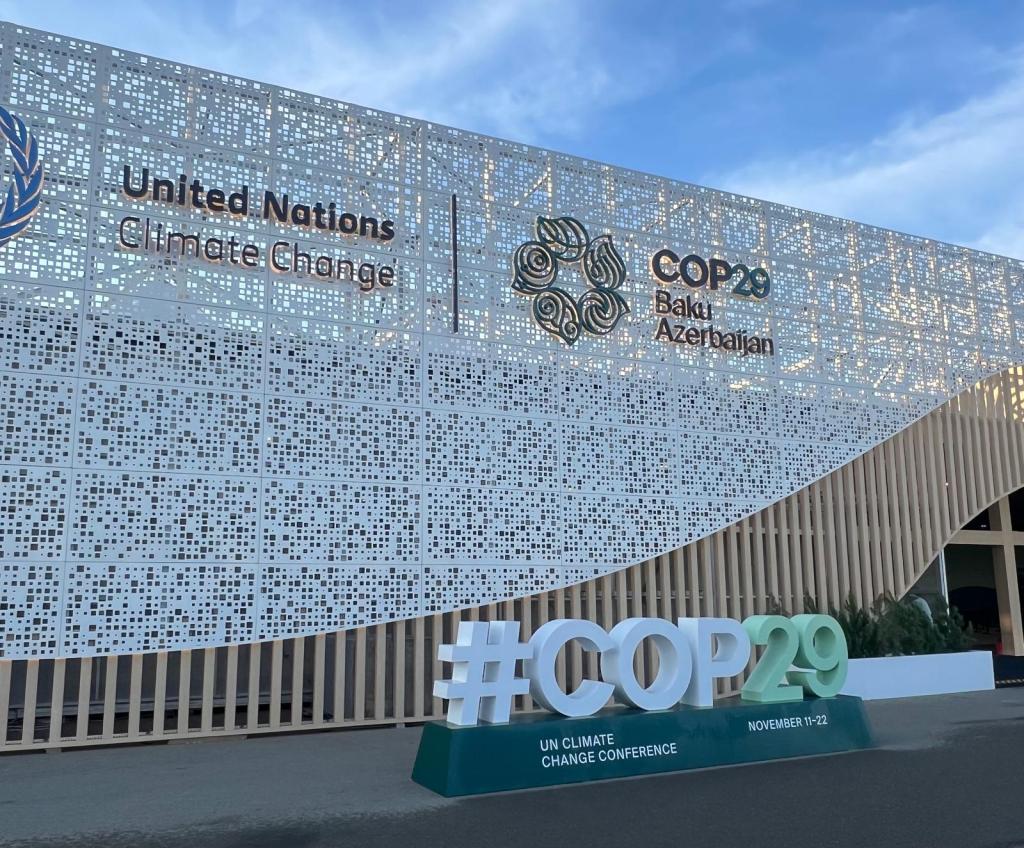
The 29th Annual Conference of Parties was held November 11th through 22nd in Baku, Azerbaijan. This was just six days after the United States elected Donald Trump as the 47th president. Trump’s intentions to pull from the Paris agreement and calling climate efforts a “scam’ brought greater questions to COP29. How would other world leaders respond to the United States’ new change of power? How do American representatives and delegates represent either the new administration, personal beliefs, or climate forward goals? It was filled with great uncertainty and tension to attend COP29 so shortly after this change of administration. No one yet knew how the administration would proceed, and unfortunately the crowd was pessimistic.
United States Involvement
International affairs and treaties have historically been a strength of republican administrations. In 1992. President George H.W. Bush attend the Rio Earth summit to adopt the U.N. Framework Convention on Climate Change (UNFCCC). As a member party, the United States committed to lessening greenhouse gas emissions and establishing “common but differentiated responsibilities and respective capabilities.” While the U.S. participated in Kyoto Protocol negotiations, complications over greenhouse gas limits and a change in administrations meant the U.S. would not ratify the agreement. During President Obama’s term he was able to ratify the Paris Agreement, a new comprehensive treaty. It would join the U.S. in an international treaty aimed at limiting greenhouse gas emissions and hold the global temperature at a reasonable level. Trump announced his intent to withdraw in his first term, and has now taken steps in his second term to do so. In Executive Order 14162, Trump ordered the U.S. Ambassador to the United Nations to which states “The United States will consider withdrawal from the [Paris] Agreement and any attendant obligations to be effective immediately upon this provision of notification.” Withdrawing from the Paris Agreement is a five year process and would not be complete within his term.
The United States delegation still had a presence from the Biden administration with leadership from John Podesta. Podesta was the former Senior Advisor for International Climate Policy and shared that the United States is on track to reduce it’s scope 3 emissions. It’s uncertain what role the U.S. will play, if any, in next year’s negotiations. Slashing of the federal work forces like the Environmental Protection Agency, and dissolution climate forward funding bills leaves the forecast bleak.
Who Pays?
COP29’s main theme was “climate finance.” Who would come up with the financial commitment needed to reduce greenhouse gas emissions and protect from climate change? Climate talks called on wealthy nations to contribute to help developing countries, citing developed nations and the primary polluters. The talks extended past the official end of the conference period spilling over into the weekend. Late on Saturday, after hours of closed sessions the conference hall erupted into chaos. Upon discussion of a $250 billion offer, the representatives from Alliance of Small Island States (AOSIS) walked out of the conference room and across the hall to a private meeting space. This event was the perfect demonstration of the tension that had been boiling for the last two weeks. The talks continued later on that night up until the early morning on Sunday. $300 billion was the final agreed upon annual pledge, despite developing nations still unhappy.
What’s Next?
A press release on January 20, 2025 states that the U.S. aims to play “a leadership role in global efforts to protect the environment.” Yet on the same day, EO 14162 was issued stating intent to withdraw from the Paris Agreement. The action does not take place until one year later, on January 27, 2026. U.S. Climate negotiators have been let go by the administration and the State Department’s Office of Global Change has been dismantled. These actions signal that the U.S. is extremely unlikely to have official representation or presence at COP30.
Looking up
While the U.S. certainly added to tensions of financing talks at COP29, it is important to remember that they are just one piece of the puzzle. There are so many other countries making great progress and standing up as leaders and advocates against climate change. Being a U.S. delegate at COP29 I almost felt out of place in observing the happenings. Yet support and optimism for the future, speaking up and doing what we can brings hope for future commitment to climate action.
Center for Climate and Energy Solutions. “History of UN Climate Talks.” C2ES, https://www.c2es.org/content/history-of-un-climate-talks/.
Library of Congress, Congressional Research Service. “U.S. Withdrawal from the Paris Agreement: Process and Potential Effects.” Congress.gov, https://www.congress.gov/crs-product/R48504.
Mirza, Zoya. “What the US Offered on Climate Action at COP29.” ESG Dive, 27 Nov. 2024, https://www.esgdive.com/news/what-the-us-offered-on-climate-action-at-cop29/734218/.
Trump, Donald J. “Putting America First in International Environmental Agreements.” The White House, 20 Jan. 2025, https://www.whitehouse.gov/presidential-actions/2025/01/putting-america-first-in-international-environmental-agreements/.
 Climate Blue