
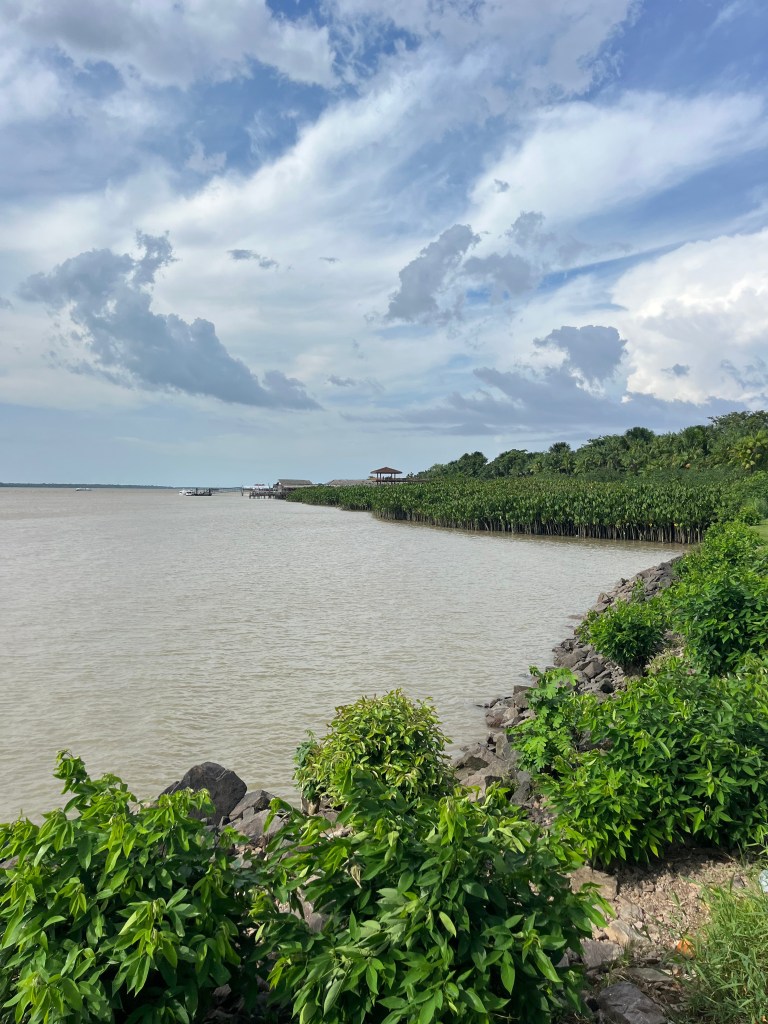
Setting the Scene in Belém
Nestled in the heart of the Amazon delta, a region where rain forest, river systems, and dense urban life converge, Belém set the stage for a unique crossover between worlds and their respective policies. While COP 30 was branded as the ‘forest COP’ there were wide arrays of agendas and priorities pursued in each biome. In this presidency, Brazil is leading the way: from co-heading the Blue NDC Challenge with France, to spearheading sustainable ocean planning and management with Norway. The COP presidency has deliberately extended its ambitions to beyond land. Waking up each morning, a whole day could be filled many times over with the sheer scale of events, panels, and discussions surrounding the ocean and its relationship to international climate policy.
The Blue N.D.C. Challenge
While the overall success of the presidency and COP 30 remains contentious and heavily debated, the hidden agenda beneath the waves of advancing ocean climate action progressed swimmingly. The Blue Nationally Determined Contribution (N.D.C.) Challenge, launched in 2025 in Nice, France, by the Ocean Conservancy, the governments of Brazil and France, and now includes 17 countries from Palau to the United Kingdom. The goal of the challenge, introduced at the United Nations Ocean Conference, is to mobilize countries to protect, restore, and utilize the ocean as a climate resource. Emphasizing the inclusion of ocean related topics in the N.D.C. 3.0 of countries, due in September 2025. However, with a significant number of countries still yet to submit their commitment, opportunities still exist to implement goals pertaining to ocean topics. Goals include utilizing the ocean to provide clean, renewable energy through responsible off-shore wind energy, tidal, and wave power and limit drilling for offshore oil and gas. Furthermore, it prioritizes sustainably managing, conserving, and restoring coastal and marine ecosystems. Finally, it emphasizes the importance of promoting the establishment of sustainable fisheries and aquaculture to enhance the livelihoods of local fishermen and communities while preserving local ecosystems. These priorities do not exist in isolation as biodiversity topics are directly connected to ecological conservation on land and many of these same strategies can be deployed in a wide variety of ecosystems: from the Mariana Trench to a suburban backyard.
Sustainable Ocean Planning and Management: Marine Protected Areas
A major component of both biodiversity and climate action in the oceans concerns Marine Protected Areas (M.P.A.s). These can serve as a buoy to adjacent fisheries, protect the breeding habitat of keystone species, and promote the protection of coastal and marine ecosystems. Many events on sustainable ocean planning and management (S.O.P.M.) took the center stage in the Climate Action area of COP 30 including a high level planning round table of Marine Protected Areas headed by the Norwegian Minister to the Environment and the Brazilian representative.
In which, it was emphasized that the speed of ocean habitat degradation is rapidly escalating due to climate change and other anthropogenic sources. From the temperature of the ocean to mangrove and seagrass degradation, the threats facing the ocean are numerous and counteractive to the Ocean’s ability to act as a carbon sink. Critical links between ocean health and carbon absorption were continually emphasized. One of the key goals of Sustainable Ocean Planning and Management is to protect 30% of the world’s oceans by 2030 (30 by 30). The Climate Action area, the Ocean Pavilion, the Moana Blue Pavilion, and special event rooms all highlighted ocean events ranging from the science of ocean microbes to international ocean policy. Across the board, indigenous knowledge was highlighted as critically important to preserving all ecosystems. Furthermore, many indigenous communities are reliant on the ocean for livelihoods; therefore, they should be engaged as a topical expert and as a critical stakeholder.
Specifically, Andreas Bjelland of Norway and Steve Victor of Palau both highlighted their country’s commitments to the 100% Alliance – a commitment to govern 100% of their waters with policies. Furthermore, the High Seas Treaty, an international agreement to protect the ocean, has 145 signatories, demonstrating a global commitment to expedite ocean action. As the sustainable development goals (SDGs) expire in 2030, there is a strong call from the ocean events at COP 30 to renew SDG 14: ‘life below water’.
Technological and Finance Barriers
Big challenges for many of the Blue NDC Challenge goals are similar to those of renewable energy technology deployment, least developed countries (LDCs) and developing nations do not have sufficient access to the technologies required for blue renewable energy deployment. There is a significant need for financing for the capacity building necessary to deploy projects on small island states. While significant developments have been made in the cost and technology of solar energy and wind energy projects, wave energy remains costly; tidal energy faces physical constraints; and offshore wind faces managerial and cost limitations.
What this lens teaches us about international climate negotiations
The Blue NDC Challenge illustrates how existing frameworks can evolve to incorporate emerging scientific understanding and modern priorities. Furthermore, it demonstrates how broad goals like NDCs can catalyze action in a variety of key areas. The inclusion in other existing regulations like the Blue NDC Challenge, demonstrate how the existing legacy of regulation can be enhanced to include modern priorities as understanding of climate science and human impacts are further understood. Moreover, it demonstrates the world’s ability to build a coalition around priorities that affect us all. The ocean also demonstrates the ‘deployment/implementation decade’ that was a theme of COP30. After the implementation of various policies, it is clear that finance and technology are critical to get to the next phase of climate action. While not all countries have direct access to the oceans, the ocean is a fundamental carbon sink for all, every country has an obligation to its protection. Furthermore, the oceans demonstrate how every country shares their oceans, similarly to the world sharing responsibility for our shared climate. Looking forward, our greatest challenge will be deploying the policies and technology needed to preserve our oceans and climate for generations to come.
 Climate Blue