
The United Nations Conference of Parties (COP) primarily centers the priorities of national delegates and their resulting climate commitments, however subnational parties, including states and cities, have risen to the spotlight of COP30.
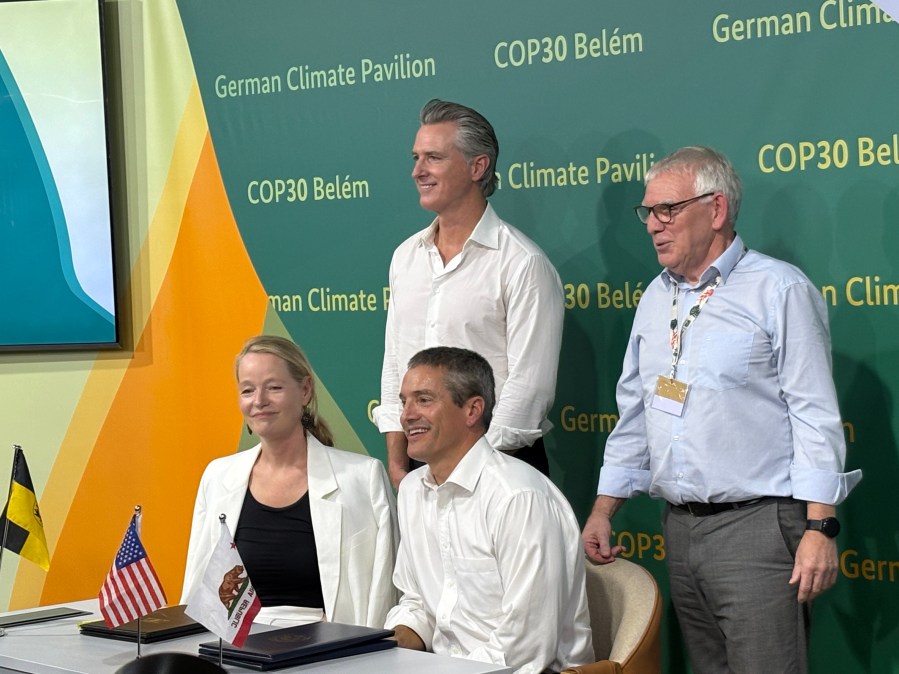
During week 1, leadership from the states of California, USA and Baden-Württemberg, Germany met at the Germany Pavilion to reaffirm their sister-state status and further their cooperative commitments on climate. These two states represent the largest economies of the United States and European Union respectively, showing the cross-sectoral success that renewable energy and sustainable development can bring.
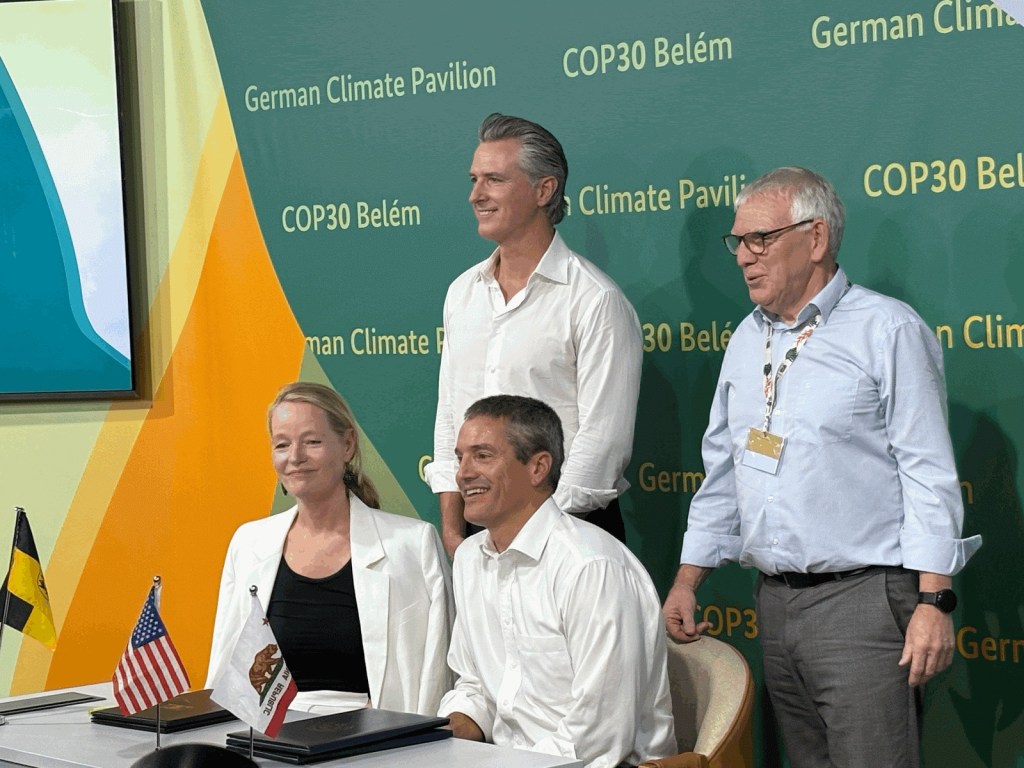
Image: Leaders Thekla Walker, Baden-Württemberg Minister for the Environment, Climate and Energy Sector [front left], California Governor, Gavin Newsom [back left] Wade Crowfoot, California Secretary for Natural Resources [front right], and Jochen Flasbath, German State Secretary of the Federal Ministry for the Environment, Climate Action, Nature Conservation and Nuclear Safety (BMUKN) [back right], pose for a photo at the end of the November 11th session at the COP30 Germany Pavilion.
The agreement was signed by California Secretary for Natural Resources, Wade Crowfoot, and Baden-Württemberg Minister for the Environment, Climate and Energy Sector, Thekla Walker. They shared a single pen to sign the agreement in a symbolic act of partnership. The document commits to further cooperation in five primary areas, including:
- Adaptation and Resilience,
- Water Management,
- Energy Transition,
- Green Technology, and
- Public Participation and Engagement.
This is particularly relevant to the Ann Arbor community, as Ann Arbor’s oldest and most active sister city is Tübingen, Germany – located within the Bundesland (state) of Baden-Württemberg. The City of Ann Arbor welcomed Tübingen leadership in a 2024 visit to reaffirm the sisterhood, including notable commitments on climate. The 2025 proclamation celebrates 60 years of partnership. Both cities are collaborating to:
- Reduce greenhouse gas emissions,
- Enhance transit options,
- Advance sustainable land use policies,
- Share promising practices related to climate action,
- Equitably address the climate challenge, and
- Achieve carbon neutrality by 2030.
Ann Arbor reflects these commitments in the Ann Arbor Township Climate Action Plan (2023) and Living Carbon Neutrality Plan (2020). Locally, we can reflect on the value of city to city partnerships to further collective sustainable futures and also look to multilateral agreements between states to encourage further action. During pre-signing presentations of the COP30 panel, Walker highlighted that, “In terms of the energy sector in Baden-Württemberg we have really achieved a lot. We have a huge expansion of solar energy. We also started to build wind turbines. We have a very good climate action law, also for adaptation. Now we have obligations for every town in Baden-Württemberg.”
Approaching climate action from the bottom-up helps ensure that the voice of the people influences action, not only those in positions of power. California Secretary Crowfoot reflected on the significance of public participation and engagement, “We have to ensure that people see themselves in this future. Whether it’s Indigenous communities in the Amazon or its people living their lives in Stuttgart or Los Angeles.”
An inclusive approach requires overcoming differences through action based on shared values. California Governor, Gavin Newsom, and German State Secretary of the Federal Ministry for the Environment, Climate Action, Nature Conservation and Nuclear Safety (BMUKN), Jochen Flasbath, discussed the importance of framing the climate conversation in terms of their constituents, regardless of political alignment. Governor Newsom reminded attendees that divided party lines are not the barrier to a sustainable future, “The modern environmental movement goes back to [the policy of] then-governor Ronald Reagan, a republican. It was codified by a President by the name of Richard Nixon. It’s been extended by democratic administrations and republican administrations. It’s not ideological.”
This year, the Trump Administration set a historic precedent with no US delegation or pavilion at COP30 and has announced the United States will leave the Paris Agreement effective January 2026. Additionally, the federal shutdown continued half way into week one of COP30 ensuring that federal staff were unable to attend. The shutdown also garnered significant criticism from other nations during the conference. Some of which sent smaller delegations specifically because of the United States’ absence. Within the US, many who voted for Trump have since changed their perspectives as Americans continue to face the cost of living crises, experience climate disasters first hand, and reflect on the ongoing shift of American politics that have taken place over the past two decades.
In sharp opposition to Trump’s anti-climate rhetoric, Governor Newsom spoke to reporters following the pavilion session, “We’ve got to stand up to him, that’s how you deal with a bully. You stand up for your principles and values, you stand up for your people. He is the most unpopular President in US history, that’s a fact. We’re going to do everything in our power to resist Trump and Trump-ism in the United States. He is not a permanent fixture.”

Image: A public demonstration in the convention hall highlights the United States as one of the most corrupt fossil fuel investors globally. Participants dress as President Trump, taking the “corruption trophy” awarded to him by a fossil fuels investor.
COP30 was unique in that a designated space was set aside in the convention center for political demonstration. Several groups used this opportunity to highlight the hypocrisy of the United State’s local and global climate impact while also retreating from necessary mitigation and adaptation commitments and further investments in the fossil fuel industry. However, regardless of party lines, all are impacted by climate change and can benefit from climate action.
Although the US federal budget for renewables has declined during the Trump Administration, several US states continue to expand renewable development. Governor Newsom celebrated, “The fourth largest economy in the world is running on 100% renewable energy nine out of ten days so far this year. Two-thirds of [California’s] grid is clean and green.” Framing the transition in terms of the needs of the people is how we can organize for collective action at a time of uncertainty. Governor Newsom reflected on California’s transition, “Alternative energy is not clean energy, it is the dominant energy now in terms of our investment. It’s a cost of living issue. It’s about affordability. And it’s about time we start to frame it accordingly.”
When concluding the session, Minister Walker discussed the need to act towards a positive future, no matter the weight of climate or political barriers. “We have to find a new narrative where we can see a positive vision of the future. People are afraid and fear is not a good source for decisions.” As we witness a global rise of conservatism, fascism, and anti-climate sentiment, subnational parties rise as leaders in climate mitigation and adaptation regardless of federal inaction.
 Climate Blue