
A Call to Action from Developing Nations
“Many of you are not in touch with your communities,” a delegate from Kenya began, “but for much of our delegation, we work closely with the frontlines as soon as we are back home. These negotiations protect the negotiators, but not the communities that are vulnerable and currently suffering. You get to go home and forget about that. When we go home, we have to answer our community. You are not connected in the same way, yet these are the people we are supposed to help.”
(Quote shortened and paraphrased for clarity)
I sat agog listening to the conviction of the Kenyan delegate giving this impassioned speech on the floor of the WIM Review on Loss & Damages meeting (COP 7/CMA 9 Review of the Warsaw International Mechanism for Loss and Damage associated with Climate Change Impacts – Informal Consultation). The atmosphere in the room shifted palpably, not just because this was coming hours before the anticipated end of COP30 and at a crucial moment for the negotiators to submit language to the COP presidency, but because of the intensity of the appeal. It cut through the typical procedural chatter, illuminating an uncomfortable truth of the disconnect between negotiators and those actually living through the climate crisis and the consequences of insufficient action.
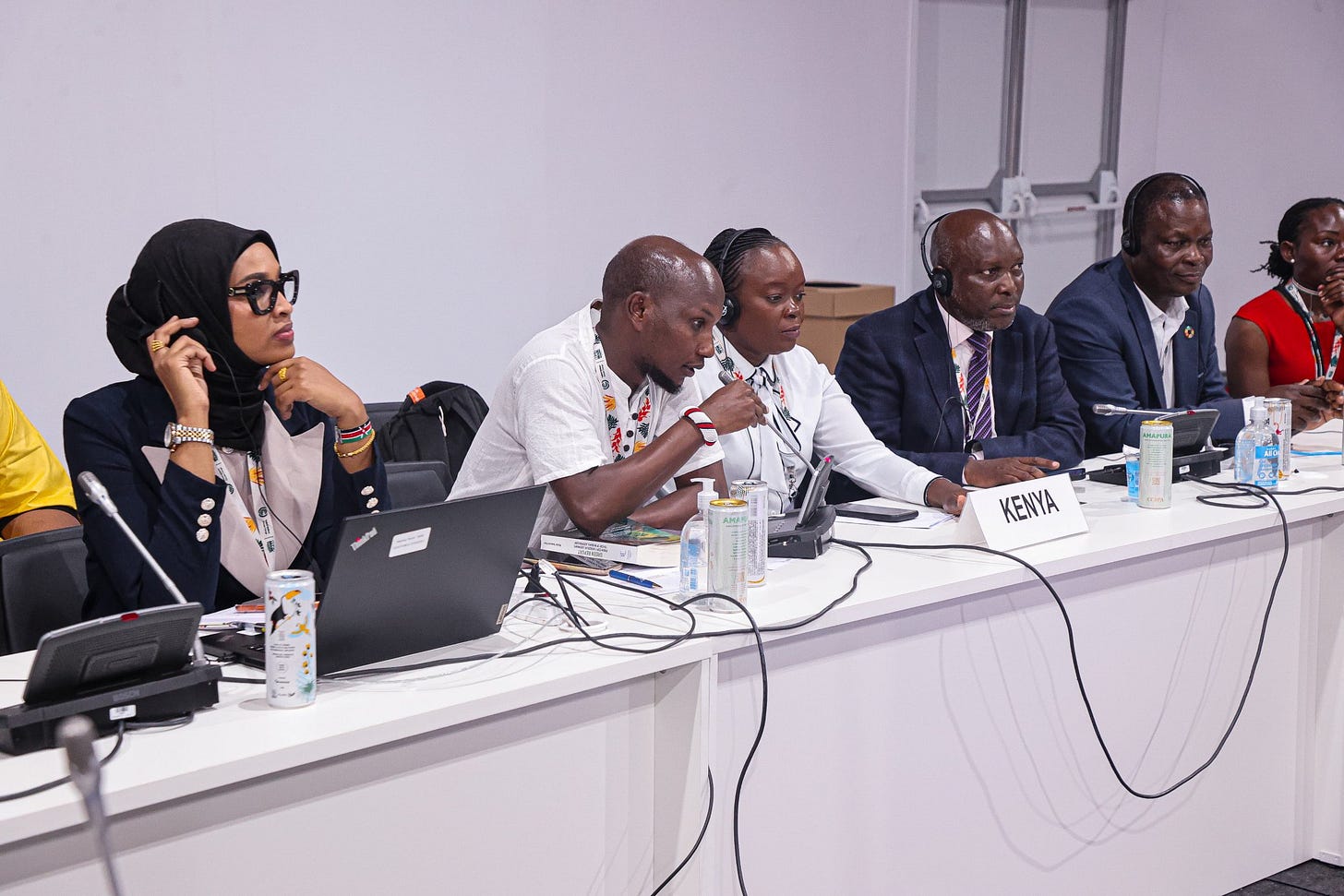
In all honesty, I wasn’t shocked by what he said, but rather was shocked he had to say it at all. Too often, these international forums become echo chambers where policy debates and financial pledges are exchanged without fully acknowledging the lived realities of the most vulnerable. The words from the Kenyan delegate forced everyone in that room to confront the stark disparity between privilege and responsibility. The increasing frequency of floods, droughts, and displacement isn’t just statistical fodder for annual reports (you can read about the landslides that happened in Kenya in the weeks prior to COP30 here) — it is the daily, traumatic reality for communities.
The Kenyan delegate’s speech overcame the sanitized language of diplomatic negotiations, replacing it with urgency and humanity. It challenged the room to break out of apathy or complacency and remember why these mechanisms, like the Warsaw International Mechanism, exist in the first place (read more about the WIM here).
The Power of Women & Indigenous Peoples at the Negotiating Table
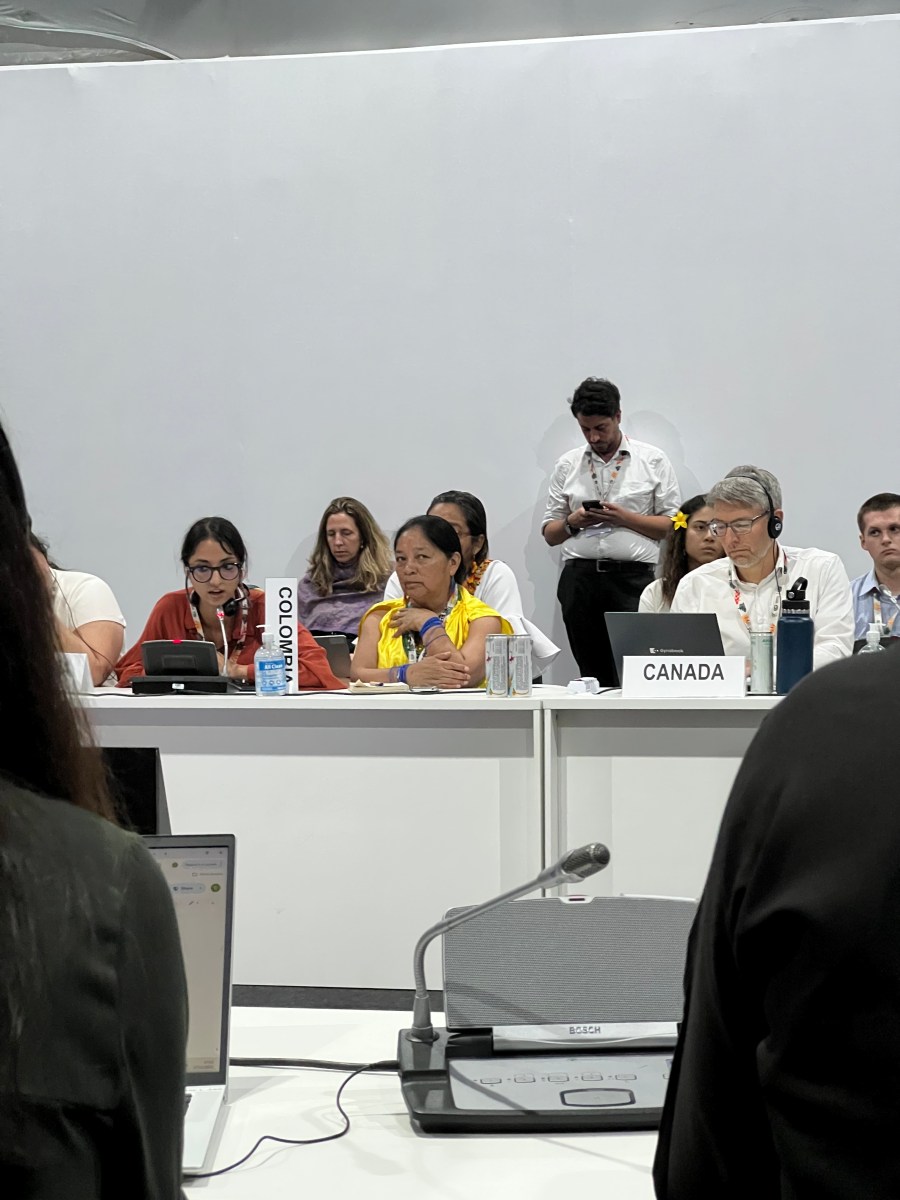
This feeling of urgency wasn’t limited to just one powerful moment. Throughout COP30, I saw delegates like Daniela Durán González from Colombia (who currently serves as the Head of International Affairs in the Colombian Ministry of Environment and Sustainable Development) consistently push the conversations deeper. Her presence in the negotiations was, in many ways, a breath of fresh air. She was one of the few delegates that represented the complete opposite end of the spectrum. In a room of older, white men, she represented the new and younger generation of climate leaders on the multilateralism stage.
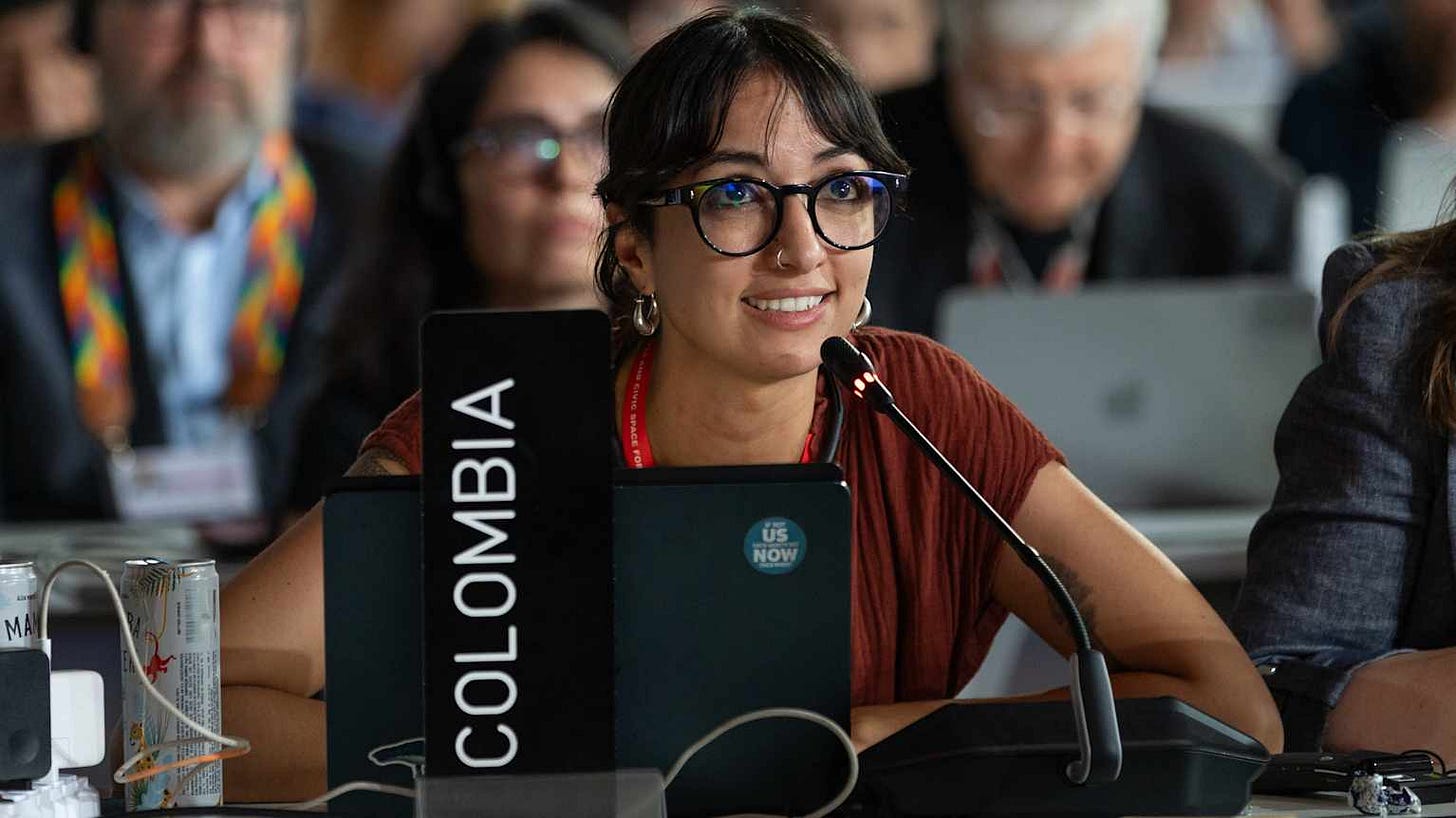
I first witnessed Daniela at the Presidency Consultation on Cooperation with other international organizations meeting (the one where I kept showing up on camera). I was inspired and impressed by the way she could hold a room every time she spoke. She was resilient and steadfast, even when the Saudi Arabian delegation kept trying to filibuster or back out from what those at the table had achieved consensus on. She served as a reminder that climate action cannot, and should not, be dictated by a narrow subset of interests or perspectives. Daniela repeatedly brought various Indigenous voices to the negotiating rooms as well to ensure that their opinions could be recognized and shared. Overall, many of the AILAC nations brought in and insisted that Indigenous voices and local knowledge be elevated in the proceedings, grounding policy debates in cultural respect and practical realities. As Daniela notes in her own reflections of COP30:
“[This was the] first formal recognition of the role of Afro-descendant peoples in climate action within the UNFCCC, through our declaration, under the leadership of Vice President Francia Márquez — and also via key decisions, including Gender, Just Transition, Mutirão, and the Global Goal on Adaptation. Indigenous Peoples, farmers, and Afro-descendant peoples were in both the decisions and in our [Colombian] negotiating team. For me, this is historic justice.”
Watching her persist, even in the face of impatience or disregard from some delegations, was a lesson in courage and conviction. Like the Kenyan delegate, Daniela reminded everyone that these negotiations were supposed to be about transformative action, not maintaining the status quo.
The call for Indigenous voices wasn’t confined to the formal negotiating rooms. During my first day at COP30, while at an afternoon special event session on Advancing coherence and synergy in leveraging traditional, Indigenous and local knowledge systems for adaptation, the skies unleashed a torrential downpour. Temporarily as the crashing of the rain deafened the mics of the speakers, we all sat in silence taking in that force of nature. As the rain gradually lessened, one panelist from an Indigenous group paused then tapped on his microphone and said,
“For many Indigenous people, the rain can be a blessing or a warning. Perhaps for this last week of COP, this rainfall is a warning that we need to start taking action.”
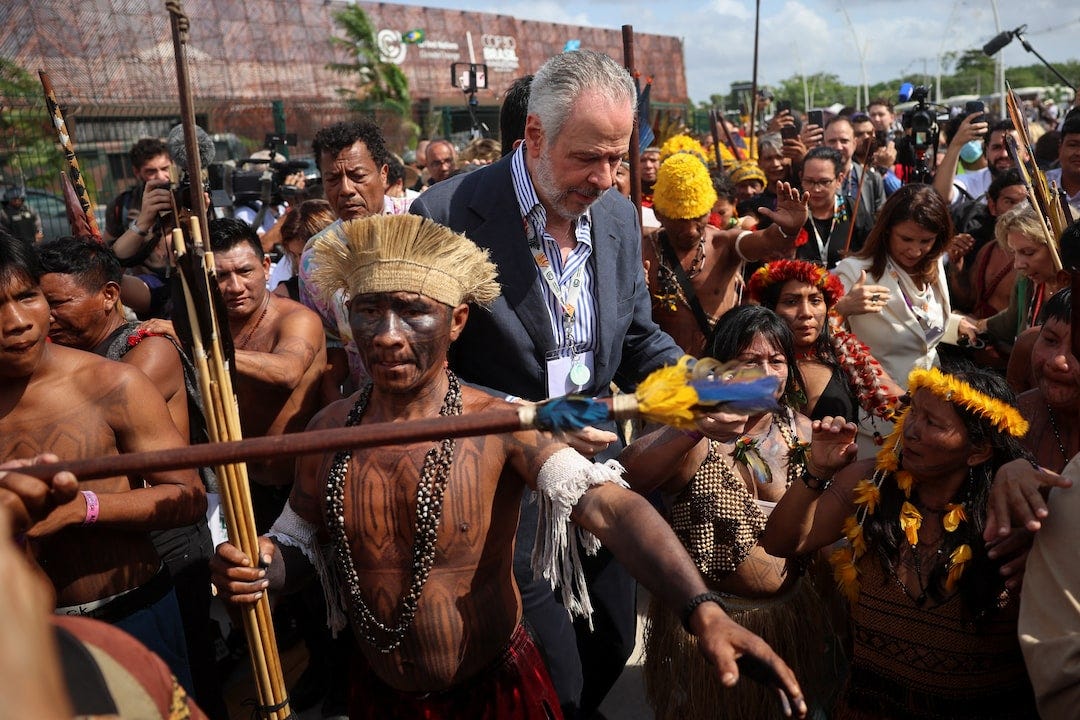
As I ended my earlier COP30 recap post, these types of moments were reminders that there is still so much action that must be taken. It calls into question the efficacy of such multilateral decisions. The stalwarts of such negotiations long to rest on their earlier laurels, but those living on the frontlines, youth who have witnessed far too many “once in a lifetime” extreme weather events, and women/girls who often bear the brunt of displacement from climate disasters (4 out 5 people who are displaced by the climate crisis are women and girls) — these are the people whose realities should be driving decisions in these negotiations, and often they are not.
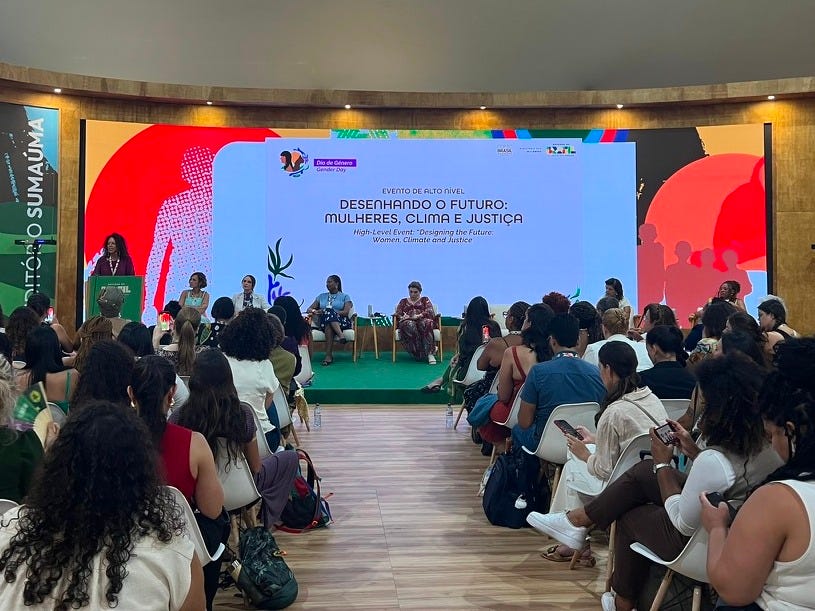
Yet, despite the lack of ambition or call to action that I felt as an observer in the negotiating rooms, I found a lot of hope going through the different booths in the Blue Zone pavilion. Most days in the party pavilion followed some sort of thematic programming. On the third day of Week 2, the theme was “Gender & Climate”. Many booths had panels focused solely on centering the work of women and youth activists and leaders in the climate space. While I didn’t spend much time here (given my inability to follow much of the Portuguese being spoken), it was great to see the Brazilian pavilion filled to the brim for a conversation on “Designing the Future: Women, Climate, & Justice”.
Listen to the Children
During one of the late night Article 6 negotiations, I was lucky to have met two youth climate activists from Chile, Nicolás and Hans. While I tried to practice Spanish and they tried to practice English, we learned a lot about the work that the Chilean government is doing on climate (a lot of which has been done so in part due to the strong youth activism in the country). Likewise, in the party pavilion, Chile was one of the few nations that opted to partner with another country (Iceland!) to highlight climate science work on topics related to the cryosphere (read more here). While their partnership may have been a result of being co-chairs to the UN’s Ambition on Melting Ice High-level Group, it was another symbolic display of the importance of collaboration between two nations thousands of miles apart, united by the shared reality of rapidly disappearing ice and the science needed to understand it.
Nevertheless, while the presence of youth at COP30 was structurally mandated, the power of youth was certainly not incidental. The Youth-Led Climate Forum (YCF), born out of Paragraph 65 of the Glasgow Climate Pact, brought together young delegates to develop concrete recommendations across three thematic areas:
- Just Transition & Climate Finance
- Food and Agriculture
- Climate Justice for Women, Girls, and Indigenous Peoples
Sitting in the closing plenary of the YCF, I was struck by how sophisticated and intersectional the demands were. Youth delegates weren’t just asking to be heard — they were calling for the explicit integration of sexual and reproductive health rights, gender-based violence prevention, and menstrual health into climate frameworks like NDCs and National Adaptation Plans. These weren’t peripheral asks, but a recognition that climate justice and bodily autonomy are inseparable.
What made the session particularly memorable was a question from a young activist from an Indigenous community in the Ecuadorian Amazon. He asked how we distinguish between children working out of genuine economic necessity versus exploitative child labor in the context of climate displacement. It was the kind of question that exposed the limits of top-down policy thinking, demonstrating how much nuance is grounded in real lived experience and is not easily answered by existing frameworks. Allies to youth activism such as Célia Alldridge from Terre des Hommes Germany and João Paulo Amaral from the Alana Institute both emphasized the need for youth participation in climate action to occur throughout the year, not just during the two weeks of COP.
Perhaps the most quietly devastating observation came not from a policy recommendation but from a simple acknowledgment that these spaces are not designed for children, and may in fact be harmful to them. Young delegates shouldn’t have to be in negotiating rooms fighting for their futures, it should be on adults to advocate for them. The sentiment echoed the Kenyan delegate’s words, that an unconscionably wide distance exists between the halls of COP and the communities that each delegation is meant to serve.
Nations on the Frontlines
The youth delegates, the Indigenous panelists, the Colombian negotiators — what united them all was the same fundamental demand: that those who have contributed least to the climate crisis not be left to bear its consequences alone. Nowhere was this more viscerally apparent than in the sessions featuring Small Island Developing States, nations facing existential threats measured not in policy timelines but in meters of sea level rise. At a session on Leveraging Climate Finance for the Pacific and Small Island Developing States (SIDS), held at the Moana Blue Pacific Pavilion, I was struck by both the ingenuity and the urgency that representatives from Tuvalu, Tonga, and Barbados brought to the table. Jamie Ovia (Director of Climate Change in Tuvalu) made clear that there is no one-size-fits-all approach when it comes to SIDS nations — each country faces its own distinct vulnerabilities and requires tailored solutions.
For Tuvalu, that has meant land reclamation efforts and coastal resilience projects supported through the Green Climate Fund’s TCAP project, which has been ongoing since the Paris Agreement. For Tonga, it has meant integrating traditional knowledge directly into technical and engineering solutions for climate-resilient infrastructure — hospitals, transport networks, inter-island connectivity, the kinds of systems that determine whether communities survive a disaster at all.
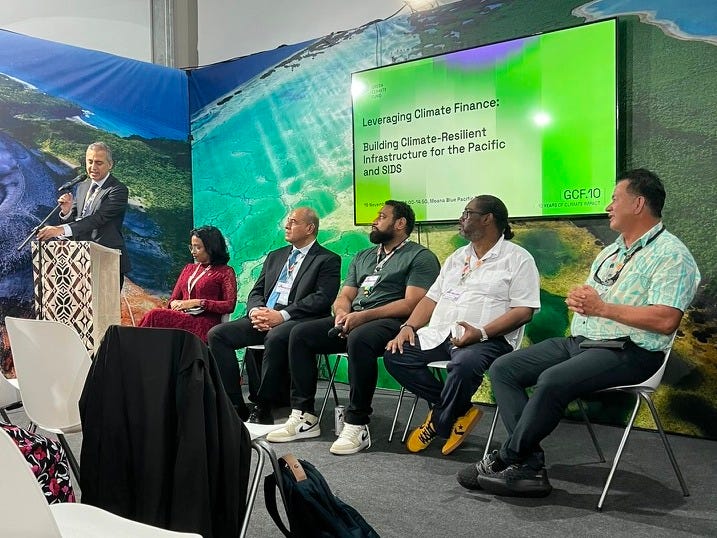
What was equally striking was the creativity these nations are bringing to climate finance itself. Ricardo Marshall (Director, Roofs to Reefs Programme, Government of Barbados) described a mesh financing model that weaves together blue and green bonds, debt-for-climate swaps, and revolving loan funds to maximize every dollar of limited fiscal space. For an island like Barbados that ranks as one of the top fifteen most water-scarce nations in the world, “you can’t wait for something to happen – you have to start doing it,” Marshall said. From rainwater harvesting targeted at farms and water-insecure communities, to community shelters built to double as climate refuges, these were not abstract policy proposals — they were practical, already-underway interventions born of necessity. Across the panel, a common thread emerged: successful models like TCAP need to be continued without funding gaps, and the knowledge gained — whether from LIDAR data collection in Tuvalu or innovative finance structures in Barbados — needs to be shared across regions so that no island nation has to start from scratch.
Looking back, the moments that stayed with me weren’t the procedural victories or the negotiated language — it was the people. The Kenyan delegate who refused to let the room forget who it was supposed to be serving. The Indigenous panelist who let the rain speak before he did. The Chilean youth activists practicing English in a corridor at midnight, unbothered by the hour because the stakes felt too high to sleep. The island nations turning fiscal scarcity into innovation. And Daniela, holding a room of older men accountable with the kind of steady, grounded conviction that doesn’t come from legacy, but rather from necessity. COP30 fell short of the ambition so many called for. But these voices ensured the conversation didn’t lose sight of justice, equity, and the urgent need for real action. It is the youth, women, Indigenous peoples, and developing nations that are forcing us to grapple with reality and reimagine what climate leadership looks like — brave, empathetic, and determined. Climate leadership and the future? It looks like them.
 Climate Blue